
Thermostat Wiring Diagram: AC Thermostat Connection Guide
A thermostat wiring diagram helps you understand how a thermostat communicates with an air conditioning system. Whether you want to replace an old controller, install a programmable AC thermostat, or learn about a Nest or Honeywell thermostat, understanding the wiring is an important first step.
In Dubai, air conditioning plays a major role in home and office comfort. However, not every AC system uses the same thermostat connections. Central AC, split AC, ducted systems, and building-managed cooling systems may require different controls. Therefore, always check your existing system before choosing a replacement thermostat.
This guide explains common thermostat connection diagrams, AC thermostat wiring labels, programmable controls, Nest compatibility, and Honeywell manuals. It also explains when professional AC thermostat installation is the safer option.
What Is a Thermostat Wiring Diagram?
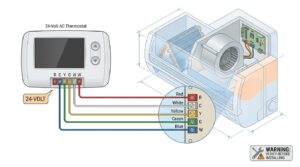
A thermostat wiring diagram is a technical drawing that shows how wires connect a thermostat to an air conditioning or heating system. It identifies the terminals, control signals, and power connections required for the equipment to operate correctly.
For example, a conventional low-voltage thermostat may use terminals labelled R, C, Y, G, and W. Each terminal serves a different purpose. However, these labels do not apply to every AC controller, particularly proprietary systems used in some Dubai apartments and commercial buildings.
A correct diagram helps technicians identify connections and troubleshoot control problems. It also reduces the risk of connecting incompatible equipment.
Important: Never rely on wire color alone. Previous installers may have used different colours, and some systems use communication wiring rather than conventional thermostat terminals.
Common Thermostat Connection Diagram and Wire Labels
Before looking at an AC thermostat wiring guide, learn what common terminal labels usually mean.
| Terminal | Typical function |
|---|---|
| R or Rc | 24-volt control power from the cooling transformer |
| Rh | 24-volt power for heating systems |
| C | Common connection for 24-volt power |
| Y or Y1 | First-stage cooling signal |
| Y2 | Second-stage cooling signal |
| G | Indoor fan control |
| W or W1 | First-stage heating control |
| O/B | Reversing valve control on compatible heat pumps |
These are general conventions, not a universal wiring plan. For instance, some thermostats combine Rc and Rh, while others require separate connections. Heat pumps and multi-stage equipment also use additional terminals.
In Dubai, many properties have cooling-only systems or controllers connected to central building equipment. Such installations may use different terminal names, proprietary interfaces, or manufacturer-specific wiring diagrams.
Understanding a Basic AC Thermostat Wiring Diagram
In a typical 24-volt cooling system, the thermostat sends a cooling request through the Y terminal and may control the indoor fan through G. The R terminal supplies control power, while C may provide a continuous power connection.
This simplified explanation helps you understand the purpose of each connection. It is not a wiring instruction for an unidentified AC system.
If your existing controller has terminals labelled A, B, 1, 2, or other unfamiliar symbols, do not assume they correspond to conventional thermostat terminals. Check the manufacturer’s diagram before considering any replacement.
What Is AC Thermostat Wiring?
AC thermostat wiring connects the room temperature controller to the equipment that regulates cooling. When the room temperature rises above the selected setting, a compatible thermostat signals the AC system to start cooling. Once the target temperature is reached, it adjusts or stops the cooling request according to the system’s design.
Correct wiring supports reliable operation. Incorrect wiring, on the other hand, can cause the AC not to start, the fan to behave unexpectedly, or the controller to lose power.
Before replacing an existing controller, check these details:
- The AC system’s manufacturer and model.
- The existing thermostat model and terminal labels.
- Whether the system uses conventional 24-volt control or proprietary communication.
- Whether the controller receives power from the AC unit or another source.
- Any building-management or central cooling restrictions.
For apartments in Dubai, consult building management when the thermostat controls a shared or centrally managed system. A replacement may require approval or a compatible controller.
How to Install a Thermostat Safely
Many people search for how to install a thermostat because they want better temperature control or a modern display. However, installation depends on the AC system, not just the thermostat itself.
A qualified technician will generally follow these steps:
- Identify the system: Confirm the AC model, existing controller, and manufacturer’s requirements.
- Isolate the power: Switch off the appropriate electrical supply before opening equipment or handling wiring.
- Document existing connections: Record terminal labels and the original arrangement for reference.
- Check compatibility: Confirm that the replacement supports the system’s voltage, control method, and cooling functions.
- Connect according to the manual: Follow the exact manufacturer-approved diagram rather than a generic online illustration.
- Mount and configure the controller: Secure the thermostat and select the correct system settings.
- Test operation: Check cooling requests, fan operation, temperature readings, and error messages.
Do not attempt this process if you cannot positively identify the wiring. Never handle exposed conductors while power is on. If the system uses mains voltage, unfamiliar communication terminals, or a central controller, leave the work to a qualified professional.
Air Conditioner Programmable Thermostat: Is It Worth It?
An air conditioner programmable thermostat allows you to schedule temperature settings for different times of the day. Instead of adjusting the controller manually, you can create a routine that suits your household or workplace.
For example, you might choose a comfortable setting before arriving home and a different setting while the property is empty. In Dubai’s hot climate, sensible scheduling can improve comfort and may help reduce unnecessary cooling.
A programmable AC thermostat may offer:
- Scheduled temperature changes.
- Easier control of daily cooling routines.
- More consistent indoor comfort.
- Reduced unnecessary operation when settings are planned carefully.
- Different programmed for weekdays and weekends, depending on the model.
However, a programmable thermostat does not automatically make every AC system more efficient. Actual results depend on insulation, outdoor temperatures, equipment condition, cooling demand, and the temperature settings you choose.
Before purchasing one, verify compatibility with your existing AC. Some systems need a specific controller to communicate correctly with the indoor unit or central control equipment.
Can a Nest Thermostat Replace Heating and Air Conditioning Controls?
A common question is: can a Nest thermostat replace heating and air conditioning controls? The answer depends on the existing system.
Google Nest thermostats support many conventional 24-volt heating and cooling systems. Hthermostat-wiring-diagramowever, compatibility is not guaranteed for every AC installation. Google’s official Nest thermostat compatibility guide explains supported systems, wiring requirements, and compatibility checks.
This distinction matters in Dubai, where some apartments use proprietary wall controllers, fan-coil units, or building-specific control systems. A standard Nest thermostat may not communicate with these systems without an approved interface, if one is available.
Before choosing a Nest thermostat, check:
- Whether your AC uses compatible low-voltage controls.
- Whether the system requires a C-wire or another power solution.
- Whether your cooling equipment uses a proprietary controller.
- Whether the Nest model supports the required fan and cooling functions.
- Whether your building permits controller replacement.
Never connect a Nest thermostat simply because the existing controller has a similar number of wires. Confirm compatibility using the official checker and the equipment manufacturer’s documentation.
What About Wiring in a Nest Thermostat E?
The Nest Thermostat E was designed for compatible systems, including certain conventional heating and cooling setups. However, supported functions and wiring requirements differ between thermostat models.
Google’s technical information lists the Nest Thermostat E as supporting one stage of heating and one stage of cooling, plus an additional stage of either heating or cooling in applicable configurations. That does not mean it will work with every ducted AC, fan-coil unit, or Dubai apartment controller.
Check the exact model’s compatibility information before buying or installing it. If your AC uses unfamiliar terminals, a proprietary interface, or building-managed controls, ask a qualified technician to assess the installation.
Honeywell Thermostat Manual: Which Guide Do You Need?
Honeywell thermostats come in different models, and their installation instructions are not interchangeable. Searching for a Honeywell thermostat manual is useful, but you must match the manual to the model number printed on your device.
The correct guide explains the terminal layout, configuration settings, power requirements, and supported equipment.
For reliable documentation, use the manufacturer’s official Honeywell Home thermostat support resources rather than relying on an unrelated diagram or an old manual.
Honeywell Home Thermostat Manual
A Honeywell Home thermostat manual can help you understand everyday functions such as temperature adjustment, scheduling, display settings, and system modes. However, user guides and installation manuals serve different purposes.
If you need to change wiring, consult the installation instructions for your exact model. A user manual alone may not provide the technical information required for safe installation.
Honeywell Pro Series Thermostat Manual
The Honeywell Pro Series includes different thermostat models with different wiring and configuration requirements. Therefore, confirm the model number before downloading instructions.
The manual may include terminal diagrams, installer settings, and details about supported cooling stages. Do not assume that two Pro Series thermostats use identical connections.
Honeywell T6 Pro Thermostat
The Honeywell T6 Pro is a programmable thermostat family with model-specific capabilities. Available versions differ in features, supported equipment, and connectivity.
Visit the official Honeywell T6 Pro product and support page to locate the relevant documentation. You can also consult the T6 Pro installation manual for supported models and wiring information.
Before installing a T6 Pro in Dubai, verify that your AC uses a compatible control system. The thermostat’s features alone do not guarantee compatibility with your existing equipment.
Common Thermostat Wiring Problems and Their Causes
A thermostat wiring issue can look like an AC fault. However, several different problems may produce similar symptoms.
The AC does not start: The cause could be incorrect configuration, a power issue, a loose connection, or a problem elsewhere in the cooling system.
The thermostat display is blank: The controller may have a power supply problem, depleted batteries, or an incompatible connection.
The fan runs but the room does not cool: The thermostat may not be communicating correctly with the cooling equipment. Alternatively, the AC may have a separate refrigeration or airflow fault.
The temperature reading seems incorrect: Poor placement, direct sunlight, nearby heat sources, or a sensor issue may affect readings.
The new thermostat does not work: The replacement may use an incompatible control method, require a different power arrangement, or need specific installer settings.
Do not repeatedly reconnect wires to test different arrangements. Instead, record the error message, model number, and symptoms, then arrange a professional inspection if the cause is unclear.
When Should You Call an AC Technician in Dubai?
Contact a qualified AC technician when your thermostat needs replacement, the wiring labels are unfamiliar, or the AC stops responding after a controller change.
Professional assistance is especially useful for ducted systems, fan-coil units, smart thermostat upgrades, and installations connected to central building controls. A technician can identify the control system, check compatibility, follow the correct diagram, and test the AC after installation.
This approach can prevent avoidable faults and help you select a controller that suits your property.
Need AC Thermostat Installation or Troubleshooting in Dubai?
Choosing the right thermostat is only the first step. Your new controller must also match your AC system and communicate correctly with its equipment.
Contact AC Maintenance Dubai for professional AC inspection, thermostat troubleshooting, and maintenance support. Our team can help assess your cooling system, investigate control problems, and identify a suitable solution for your property.
Whether you are dealing with an unresponsive thermostat, planning a programmable controller upgrade, or unsure about Nest or Honeywell compatibility, arrange an assessment before changing the wiring.
Get in touch with AC Maintenance Dubai to discuss your AC problem and find the right next step for reliable indoor comfort.